2026.10.23 ”Welcoming a Guest Speaker (From the Job Hunting Seminar)”
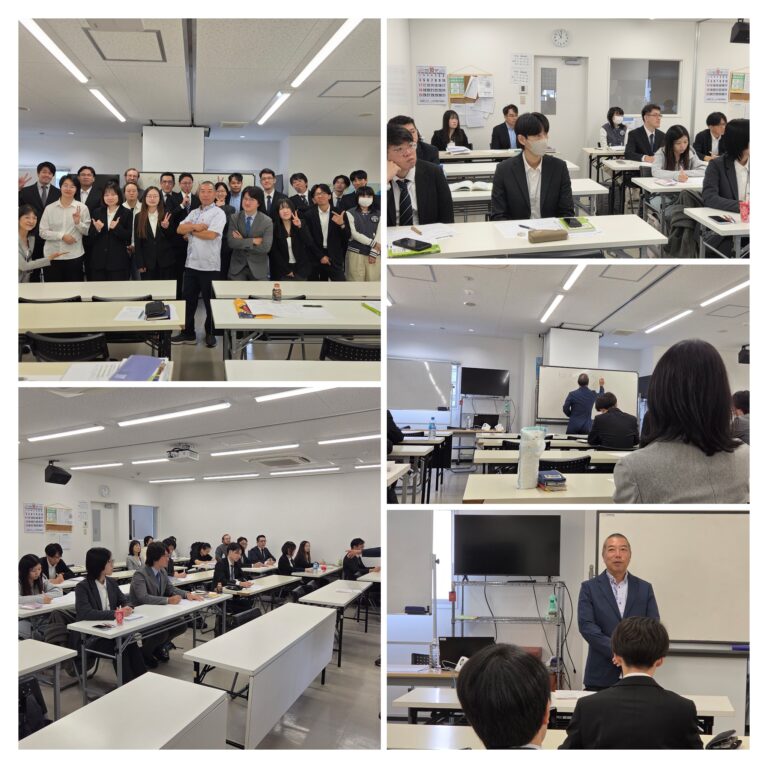
This term, we welcomed Mr. Kohei Katsuma (勝間 恒平/かつま こうへい), who has spent many years working in various areas of local government and serving the community.
Motivated by his desire to help people, he joined Kobe City Hall, the municipal government of a designated major city in Japan. However, the work carried out by a city government is remarkably diverse. His responsibilities have included solving local community problems, managing an art museum, supporting regional revitalization, assisting with recovery efforts in disaster-affected areas outside Hyogo Prefecture, and organizing international events. His work has involved a wide range of professions and industries, requiring him to listen to the opinions of many different people-from individuals to organizations-coordinate their views, bring them together, and take action to resolve problems.
Through these diverse experiences, he came to realize that communication styles such as “ishin-denshin” (understanding one another without having to put everything into words) and “sassuru” (sensing or anticipating another person’s thoughts and feelings) play a significant role in getting things done. He also realized how difficult these forms of communication can be. These approaches can be considered characteristic of Japanese culture. However, as the number of foreign residents from different cultural backgrounds has increased in recent years, questions have arisen about what forms of communication are most appropriate. Mr. Katsuma discussed these issues by introducing practical examples and explaining the characteristics of different expressions.
Even international students with advanced Japanese-language skills still have limited experience with Japanese conversations that take cultural codes and unspoken social expectations into account. Such communication skills are particularly essential in the business world, so the students listened to his presentation with great interest.
At the end of the session, he gave the students an assignment: to create a “Guide on How to Handle Foreigners” aimed at Japanese people. As Japanese society increasingly encounters people from diverse ethnic and cultural backgrounds, the goal is to develop a reference resource that helps people recognize that foreign residents may act according to different cultural perspectives, customs, rules, and manners. The resource should encourage greater awareness and understanding and serve as a guide toward building a harmonious society.
Two months later, all students from the two business classes will be divided into groups and give presentations on their work.